 North Atlanta Flagpole Crew
Flagpole Installation and Repair Services in Roswell, GA
North Atlanta Flagpole Crew provides flagpole installation and repair throughout North Metro Atlanta for homeowners, businesses and public buildings. We install in-ground fiberglass and aluminum flagpoles at front yards, storefronts, schools and office parks. Our most common repairs include frayed halyards, broken snap hooks and jammed internal winches, along with replacing missing finials or ball toppers. Contact us for a free quote today.
-
What Flagpole Installation and Repair Actually Covers
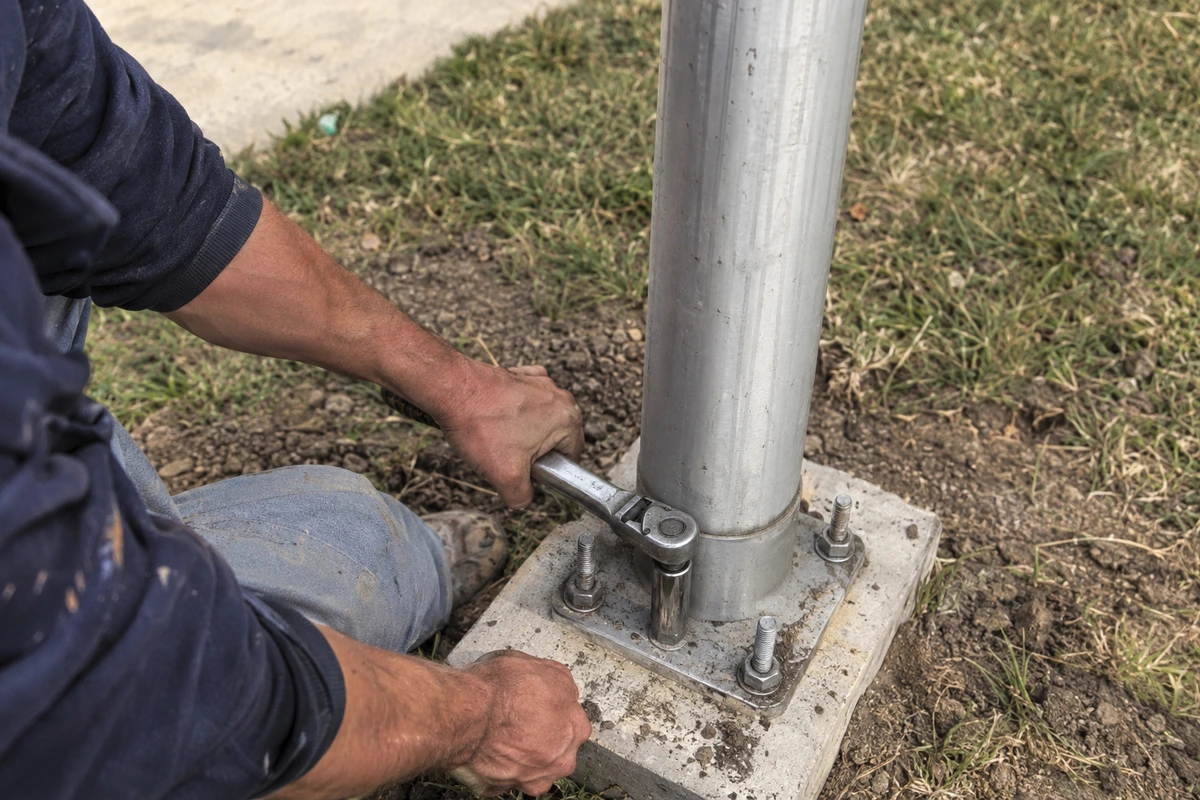
A residential in-ground flagpole is a tapered aluminum or fiberglass shaft set inside a ground sleeve, which is a steel or PVC tube locked into a concrete footing. On top sits the truck, a cap with a pulley that the halyard rope runs over, crowned by a ball or eagle finial. At the base, a cleat or an internal winch holds the halyard tight, and a flash collar covers the joint where the pole meets the ground. Poles fail in predictable spots: halyards fray in UV, truck pulleys seize, and moisture at grade corrodes the base or lets the footing settle until the pole leans. Embedment depth, footing size and a pole rated for local wind loads decide whether a pole stands straight for decades. Re-roping a leaning pole or plumbing it with shims leaves the actual problem in the ground.
-
When Flagpole Installation and Repair Makes Sense
A slow lean of a degree or two gets mistaken for an optical trick or an uneven lawn, when it usually means the footing has shifted or the sleeve has rusted through. Leaning matters most, because every windstorm works a loose base further out of plumb. Hardware wear at the top tends to get worse slowly.
- Pole visibly tilting or rocking when pushed at chest height
- Halyard frayed, sun-bleached or stuck so the flag won't lower
- Truck pulley squealing, seized or missing its finial
- White corrosion or pitting where the pole meets the ground
- New home, building or memorial with no pole yet
- Old pole bent or kinked after a storm
-
Our Flagpole Installation and Repair Process
The pole base and ground sleeve get checked for plumb with a level and for corrosion or rot at grade before anything else is decided. On an existing pole, we lower the flag, pull the halyard, and inspect the truck pulley and finial from a ladder or lift. For a new install or a failed footing, buried utilities are marked through the 811 locate service, then the site gets laid out and the hole dug with a post-hole auger or by hand to roughly one-tenth of the pole's exposed height in depth. The ground sleeve is set on a gravel base, braced plumb and backfilled with concrete. Once the concrete sets enough, the pole is lifted into the sleeve, centered with steel or wooden wedges, and the gap packed with dry sand. We cap the sand with sealant, slide the flash collar down, mount the cleat or winch, and run a new halyard with snaps through the truck. A final check with a level on two faces confirms plumb, and a test raise confirms the flag runs smoothly to the top.
-
Equipment and Materials Used in Flagpole Installation and Repair
Commercial-grade tapered aluminum is the usual pole choice because it resists rust and flexes in wind without snapping, unlike thin straight-wall tubing. Fiberglass gets picked near the coast or where the client wants a pole that won't conduct heat or show oxidation. Galvanized steel ground sleeves are used instead of setting the pole straight into concrete, so a damaged pole can be pulled out and replaced without breaking up the footing. Dry sand fills the sleeve gap rather than more concrete because it holds the pole firmly while still letting it come out. Braided polyester halyard outlasts cotton or nylon in sunlight and stretches less. A sealed ball-bearing truck turns freely in ice and dust, where a plain bronze bushing grinds. Internal halyard systems with a locked access door keep the rope out of reach of vandals.
-
Can You Do Flagpole Installation and Repair Yourself?
Hardware work on a short pole is homeowner work; setting or straightening a full-height in-ground pole is not. Replacing a halyard, snaps or a cleat on a pole up to about 20 feet is manageable if the truck can be reached from a sturdy extension ladder or the pole has a hinged base. A wall-mounted bracket on a porch is also a homeowner job. The line comes at in-ground poles around 20 to 25 feet and up, which weigh enough that tipping one into a sleeve takes several people or a boom truck. Digging near buried lines, working close to overhead wires, and getting a pole's wind rating wrong are where a mistake gets dangerous. Uplighting belongs to a licensed electrician.
-
What Makes a Flagpole Installation and Repair Job Bigger
Exposed pole height sets the hole depth, footing volume and lifting method, since a taller pole needs a deeper sleeve and often a boom truck. Broken-up old concrete, rock or tree roots usually aren't obvious until the auger stops.
- Pole height above about 25 feet needing lift equipment
- Removing an old pole and its concrete footing
- Rocky, root-filled or saturated soil at the hole
- Internal halyard or winch systems instead of external rope
- Tight access with no room for a truck or lift
- Rusted-through sleeve requiring a new footing entirely
-
How Long Does Flagpole Installation and Repair Take and Last?
A typical flagpole installation and repair job runs a few hours to a full day, with halyard and truck repairs usually done in an hour or two and a 20-foot residential in-ground install taking most of a day. Removing an old footing, rocky digging and taller poles that need lift equipment stretch it, and some crews set the sleeve one day and the pole the next once the concrete firms up. A well-set aluminum pole typically stands for 20 to 30 years or more. Halyards usually need replacing every three to five years, and truck pulleys commonly need attention within ten.
-
What Comes After Flagpole Installation and Repair
Lighting is the follow-on job that most often comes next, since flying the flag overnight under common flag etiquette calls for illumination. An electrician runs buried wire to a ground-mounted uplight, or a solar light mounts at the truck. Ongoing upkeep stays mostly at the top of the pole.
- Inspect the halyard for fraying each spring and fall
- Lubricate or replace the truck pulley when it starts squealing
- Replace sun-faded or torn flags before the fly end shreds
- Bring in an electrician to wire a ground-mounted uplight
- Reseal the sand cap at the base every few years
-
How Much Does Flagpole Installation and Repair Cost in Roswell, GA?
Flagpole installation and repair in Roswell, GA typically costs $232 to $3,211. Swapping a halyard or truck pulley sits at the low end, while a new 20- to 25-foot in-ground pole with a sleeve and footing sits at the high end. Exposed pole height drives most of the price: a taller pole needs a deeper hole, more concrete and often a boom truck to set it. Removing an old pole and its footing, digging through rocky or root-filled soil, and adding an internal winch halyard system all raise the cost.